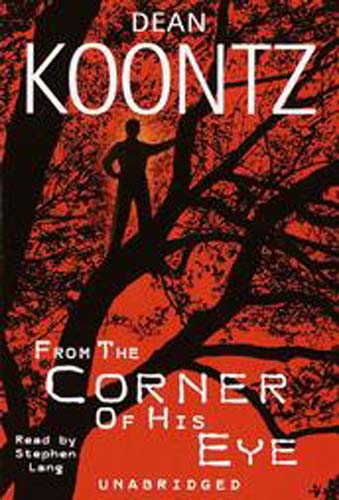
Every good deed no matter how small resonates and affects the lives of people we don't know and the next generation to come. Not the exact words of Dean Koontz but that pretty much sums up what he was trying to say in From the Corner of His Eye. This is one of his books that shows the contrast between good and evil. Just black and white, no grays. This has been the trend of his most recent works and I was not surprised that Agnes Lampion and Enoch Cain, Jr. were so different from each other. They represent the two extreme sides of humanity. The former is considered a hero loved by everyone, the latter is human dirt, despised by all those who see him.

Enoch Cain, Jr. or Enoch is perhaps the craziest Koontz villain I have read. Not only is he a megalomaniac, he lacks remorse, has a really bad temper and is also prone to superstition. It was not explained how he became like that, although there were hints that he had been abused by his mother as a child. Unlike Koontz's older books, I guess he did not need to justify Junior's madness. His death, if it can even be considered as death, was too quick and unexpected but looking back I think it was the best way for him to go. His crime aftermaths are so funny and unique. I haven't seen characters from his other books react that much.
In contrast to Junior, the other characters look like saints. Although I don't have issues with such type of characters, Agnes Lampion seems way too over the top. Like Junior, she was abused but she did not turn out so bad. Instead of becoming like her father or making herself a victim to someone else, her experiences did not leave emotional scars on her. Her brothers however were traumatized. But they coped better than Junior too.
Other than that it is a typical Koontz book: in-depth character development, vivid descriptions, unusual weather occurences during important events, and a formidable villain.
Some of the most memorable things I've read are his descriptions. It's one of the things that makes Koontz really special because not a lot of writers could write like he does.
While most writers settle for a few simple words to describe a character, this passage shows Koontz's power to take one metaphor even further:
"Ned - call me Neddy - Gnathic was as slim as a flute, with a flute-quantity of holes in his head from which thought could escape before the pressure of it built into an unpleasant music within his skull. His voice was always soft and harmonius, but frequently he spoke allegro, sometimes even prestissimo, and in spite of his mellow tone, Neddy at maximum tempo was as irritating to the ear as the bagpipes bleating out Bolero, if such a thing were possible."
Other writers would simply just settle with the flute. Here's another one describing a character's teeth:
"White as a Viking winter, these magnificent choppers, and as straight as the kernel rows in the corn on Odin's high table. Superb occlusal surfaces. Exquisite incisor ledges. Bicuspids of textbook formation nestled in perfect alignment between molars and canines."
I liked how Koontz was able to integrate religion and science in the last part of the book. What the others would have taken pages to discuss, he was able to explain in a few paragraphs. He was also able to include the theme that people are interconnected through some ways we cannot see. In this case, the characters were united because they were inspired by one person's words and because they have to wield the same words against a foe.
The last part of the book took a bit too long because the special abilities of Thomas, Bartholomew and Angel are only slightly connected with Junior's story.
This isn't one of my favorites from Koontz but I still enjoyed it.
Enoch Cain, Jr. or Enoch is perhaps the craziest Koontz villain I have read. Not only is he a megalomaniac, he lacks remorse, has a really bad temper and is also prone to superstition. It was not explained how he became like that, although there were hints that he had been abused by his mother as a child. Unlike Koontz's older books, I guess he did not need to justify Junior's madness. His death, if it can even be considered as death, was too quick and unexpected but looking back I think it was the best way for him to go. His crime aftermaths are so funny and unique. I haven't seen characters from his other books react that much.
In contrast to Junior, the other characters look like saints. Although I don't have issues with such type of characters, Agnes Lampion seems way too over the top. Like Junior, she was abused but she did not turn out so bad. Instead of becoming like her father or making herself a victim to someone else, her experiences did not leave emotional scars on her. Her brothers however were traumatized. But they coped better than Junior too.
Other than that it is a typical Koontz book: in-depth character development, vivid descriptions, unusual weather occurences during important events, and a formidable villain.
Some of the most memorable things I've read are his descriptions. It's one of the things that makes Koontz really special because not a lot of writers could write like he does.
While most writers settle for a few simple words to describe a character, this passage shows Koontz's power to take one metaphor even further:
"Ned - call me Neddy - Gnathic was as slim as a flute, with a flute-quantity of holes in his head from which thought could escape before the pressure of it built into an unpleasant music within his skull. His voice was always soft and harmonius, but frequently he spoke allegro, sometimes even prestissimo, and in spite of his mellow tone, Neddy at maximum tempo was as irritating to the ear as the bagpipes bleating out Bolero, if such a thing were possible."
Other writers would simply just settle with the flute. Here's another one describing a character's teeth:
"White as a Viking winter, these magnificent choppers, and as straight as the kernel rows in the corn on Odin's high table. Superb occlusal surfaces. Exquisite incisor ledges. Bicuspids of textbook formation nestled in perfect alignment between molars and canines."
I liked how Koontz was able to integrate religion and science in the last part of the book. What the others would have taken pages to discuss, he was able to explain in a few paragraphs. He was also able to include the theme that people are interconnected through some ways we cannot see. In this case, the characters were united because they were inspired by one person's words and because they have to wield the same words against a foe.
The last part of the book took a bit too long because the special abilities of Thomas, Bartholomew and Angel are only slightly connected with Junior's story.
This isn't one of my favorites from Koontz but I still enjoyed it.
Comments
Post a Comment
Comments are always welcome! Please keep it clean.