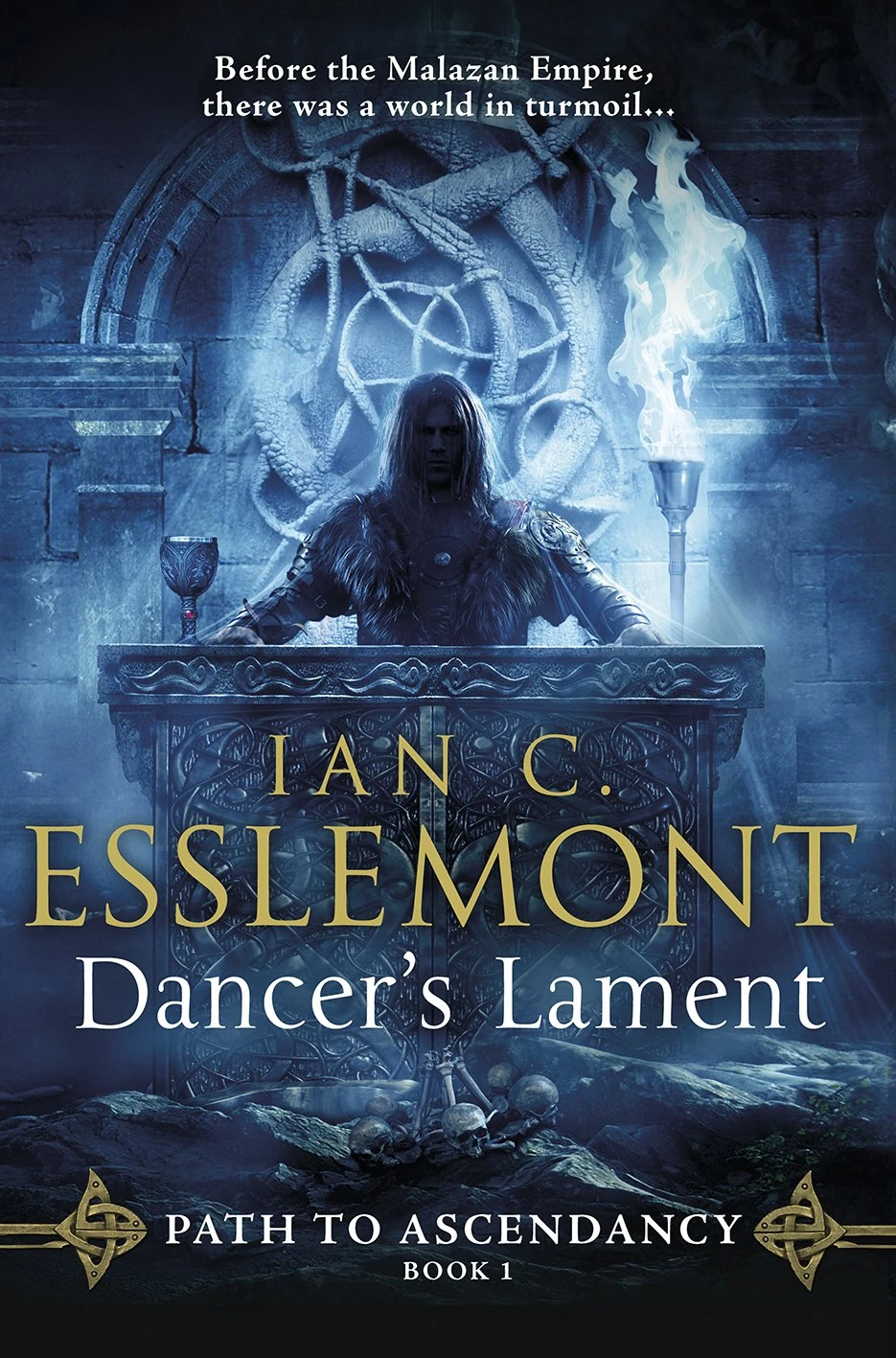
Dancer's Lament by Ian C. Esslemont


Set in Li Heng, this first installment of the Path to Ascendancy series follows the story of Dorin Rav, an ambitious young assassin, who is stumped by an elusive young mage proving to be an annoyance. An earthquake in the Seti Plains exposed a cave and Dorin wanted to be the first to discover its secrets. To his dismay, he learned someone has been lurking about in the shadows. No one has ever beaten him yet until now. He watched for a time, waiting for the person to appear. When he finally got inside the cave he found that it was occupied by a talking corpse and a monkey-looking thing. To Dorin's surprise, the person he was following was just standing behind him. A young Dal Honese mage, Wu, who professed he was the one following Dorin. When they got out of the structure, the mage Wu suddenly disappeared. Since then, Dorin called the mage his rival and vowed he would find and eliminate him. 

Li Heng is ruled by a mage known as Protectress who has a cabal of five. Li Heng has been relatively peaceful despite the prominence of gangs, but Silk is worried for the Protectress Shalmanat. Strange events are happening and even stranger people are showing up. The cult of Hood for example, long outlawed in Li Heng, are gathering new believers. Foremost among their worries however are the rumors that Itko Kan and its king, Chulalorn the Third, are marching.

Iko's first impression of the city was disappointment. A member of Itko Kan's Sword-Dancers, she and her sisters were sent on a political mission to the Protectress to escort a diplomat who will deliver terms to Li Heng. Her time at the palace grounds however proved to be fruitless. What's more, her sisters have become obsessed with rivalries and gossips among themselves. Iko did not want to be involved in any of that, but as a result she has isolated herself. 

Meanwhile, Dorin's obsession at capturing Wu is proving difficult. Dorin is used to working alone but he could not find Wu that way. He decided that he has to gain a reputation in the city and involve himself with the local gangs. His arrogance however might attract the attention of people more skilled and experienced than him.

***

Dancer's Lament is Ian C. Esslemont's best book so far. I enjoyed everything in the book from start to finish. Not only was it amusing to follow Dorin and Wu's misadventures, I've also learned a lot of things about Dancer and Kellanved in general. They were already among the most interesting pairs in Malazan so my initial worry was how Esslemont would be able to add to their famous story. There was nothing to worry at all. He knew them very well. Only those who haven't paid attention to the books would fail to recognize them right away.

I loved all the cameos too. Most of the characters who are in the Novels of the Malazan Empire series had back stories that were not fully explored. It's exciting to finally get a glimpse of their past.

The action scenes, the intrigues and the humor are all signature Malazan. One of Esslemont's strongest qualities is his description and imagery. I loved Blood and Bone but this is even better. If you don't enjoy (or fall in love with!) the adventures of Dorin and Wu after reading this then I'd have to question your bad taste. Also, if you've been skipping Esslemont (I've heard some Malazan fans don't want to read his books) then you're missing a lot.

He's also not given to philosophizing. Broody characters can be tedious sometimes when not done properly. That does not make his work shallow however. Esslemont's storytelling is smooth, concise and clear.

The only drawback I see is how he'd be able to fit everything in just three books. Dancer's Lament covered only a small part of Dorin and Wu's past. They were just getting to know each other. The book felt more like an introduction and a set-up for the next two books, but I hope that there is still enough room to not leave out any important event.

Rating: 10 out of 10

Comments

Popular Posts

Deities and Mythical Beings of the Davao Tribes

Note: I don't claim to be an expert in the mythology and religion of the six tribes featured here. My source for this information is Fay-Cooper Cole's The Wild Tribes of Davao District, Mindanao. This entry is solely a list for future references. The deities and mythological creatures here are from Fay-Cooper Cole's The Wild Tribes of Davao District, Mindanao . This is a list of the gods, goddesses, and spirits/spirit classes of the Bagobo, Bila-an, Kulaman, Tagakaolo, Ata, and Mandaya. I retained the spelling of the names found in the book. For full accounts of the myths and customs of the tribes, I recommend reading the book. BAGOBO Eugpamolak Manobo/Manama/Kalayagan  - first and greatest creator whose home is in the sky. Offerings for him should be white. Tolus ka balakat - name means "dweller in the balakat"; loves blood but not the flesh of humans and is one of the three deities for whom the yearly sacrifice is made. Mandarangan and Darago - husba...

An Analysis of the Enuma Elish (The Epic of Creation) or The Seven Tablets of Creation, A Babylonian Creation Myth

*Note: This was a term paper for a class. Since I don't know what grade the professor gave me (or of she even read the paper at all), I decided to post it here. The Enuma Elish is also called The Seven Tablets of Creation. It documents the Babylonian creation epic. It was recorded in seven clay tablets found at various locations including the infamous library of Ashurbanipal at Nineveh, discovered by Austen Henry Layard. The name of the hero of the epic varies depending on where the tablet is found. The most common version tells of Marduk as the hero. In other versions, the god of the city is considered the hero. Introduction The title of the epic is taken from its opening line “When in the height, heaven was not named...” The epic chronicles Marduk’s war against Tiamat. He leads the other gods against the old divinity who had turned against her children. Besides Marduk’s exploits, the epic also tells about the birth of the gods and goddesses and the creation of the universe....

The Ghost of Sparta: A Review of the God of War Series

Several adaptations of Greek Mythology in media have appeared over the years. Some were successful while the others have failed to represent the ancient Greeks. Among the most memorable I've encountered is this series. Not only was it able to illustrate the heroes, monsters and gods in myths, but also brought to the fore the often ignored question - what happens to the Greek pantheon after they defeated the Titans? It is unique because the hero in this game is not a hercules-achilles-jason clone. The protagonist is a minor figure in Greek mythology. Kratos (Cratos) is a servant of the gods and one of Zeus' children, which is close enough to the real version (Cratos is not a child of Zeus, but one of his servants along with Nike). And unlike most heroes, he does not carry weapons to save humanity. He seeks revenge to cleanse his past. The series began when he sought to kill Ares, the God of War.  He was finally able to kill Ares with the help of the other gods. The portrayal...

Literary Theory and Criticism

Note: This is my final paper for Adv. Literary Theory and Criticism, one of my classes in MA in Literature.  October 2015. I'm posting this here as a backup in case I lose my copy and I need a guide in the future. Literature is the soul of a civilization. It is the collection of dreams, ideas and experiences of a people. It is what separates us from animals. It is an examination of our aspirations, happiness, fears and sadness, ideas and opinions. As a student of literature, I have learned that to get the most out of a poem, short story, novel, play or film, I must go beyond simple reading and observation. To do this however, I have to answer first the question "how do we fully appreciate a literary piece?" This essay is divided into four sections, namely; what is literature for me; the literary theories and criticism; Heneral Luna: a film review using the poststructuralist approach; and what makes a good literature? In the first part, I will recall my experiences a...