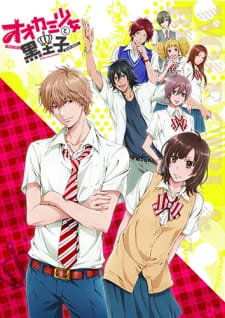
Ookami Shoujo to Kuro Ouji


Shinohara Erika wants to make new friends at the start of the school year, but she's unsure how to do that. While looking around the classroom, she overhears two girls talking about their boyfriends. That was her cue. She tells them about her romantic exploits with a hot boyfriend---all lies just to impress them. Later her friends pressured her to show a photo of the said boyfriend. Erika then takes a photo of a good-looking guy she saw on the street and then ran away thinking her problem was solved. To her surprise, one of her friends recognized the guy as one of their schoolmates. Trapped, Erika begs the guy in the photo, Sata Kyouya, to play her boyfriend for a while. The kindly, prince charming Kyouya gladly accepted, but he soon showed his true face to Erika when he started blackmailing her. This 12-episode series follows Erika's misadventures with pretend-boyfriend Kyouya.


Erika takes a photo of a random guy

Erika and Kyouya pretending to be dating


The series began like all the other shoujo comedy-romance series, but what set it apart was the development of the relationship of Erika and Kyouya.

Erika's character is consistent (although predictable) throughout the series, while Kyouya's has slight changes that got me wondering. He started off as socially-adept though that was just one part of his personality. Then in later scenes with other people, he became cold and silent. Though this was after he started going out with Erika, I'm puzzled if he really is a tsundere or if Erika actually changed him though no one remarked about the differences. That minor issue aside, I think most of the elements of the series are okay.

One thing I noticed that isn't always present in other shoujo romance is the issue of jealousy experienced by the lead male character. It is usually the female who gets jealous and competes with another girl (typically her friend as well) for the attention of the male. The part where Kyouya gets jealous was the best scene because I don't see that often.

Ookami Shoujo to Kuro Ouji has an overload of romantic scenes that will make you squeal like a young girl. Although the approach to the development of their romantic feelings is typical of shoujo, I like how they made the lead male slightly more aggressive in pursuing the girl.

Rating: 9.5 out of 10

Comments

Popular Posts

Deities and Mythical Beings of the Davao Tribes

Note: I don't claim to be an expert in the mythology and religion of the six tribes featured here. My source for this information is Fay-Cooper Cole's The Wild Tribes of Davao District, Mindanao. This entry is solely a list for future references. The deities and mythological creatures here are from Fay-Cooper Cole's The Wild Tribes of Davao District, Mindanao . This is a list of the gods, goddesses, and spirits/spirit classes of the Bagobo, Bila-an, Kulaman, Tagakaolo, Ata, and Mandaya. I retained the spelling of the names found in the book. For full accounts of the myths and customs of the tribes, I recommend reading the book. BAGOBO Eugpamolak Manobo/Manama/Kalayagan  - first and greatest creator whose home is in the sky. Offerings for him should be white. Tolus ka balakat - name means "dweller in the balakat"; loves blood but not the flesh of humans and is one of the three deities for whom the yearly sacrifice is made. Mandarangan and Darago - husba...

An Analysis of the Enuma Elish (The Epic of Creation) or The Seven Tablets of Creation, A Babylonian Creation Myth

*Note: This was a term paper for a class. Since I don't know what grade the professor gave me (or of she even read the paper at all), I decided to post it here. The Enuma Elish is also called The Seven Tablets of Creation. It documents the Babylonian creation epic. It was recorded in seven clay tablets found at various locations including the infamous library of Ashurbanipal at Nineveh, discovered by Austen Henry Layard. The name of the hero of the epic varies depending on where the tablet is found. The most common version tells of Marduk as the hero. In other versions, the god of the city is considered the hero. Introduction The title of the epic is taken from its opening line “When in the height, heaven was not named...” The epic chronicles Marduk’s war against Tiamat. He leads the other gods against the old divinity who had turned against her children. Besides Marduk’s exploits, the epic also tells about the birth of the gods and goddesses and the creation of the universe....

The Ghost of Sparta: A Review of the God of War Series

Several adaptations of Greek Mythology in media have appeared over the years. Some were successful while the others have failed to represent the ancient Greeks. Among the most memorable I've encountered is this series. Not only was it able to illustrate the heroes, monsters and gods in myths, but also brought to the fore the often ignored question - what happens to the Greek pantheon after they defeated the Titans? It is unique because the hero in this game is not a hercules-achilles-jason clone. The protagonist is a minor figure in Greek mythology. Kratos (Cratos) is a servant of the gods and one of Zeus' children, which is close enough to the real version (Cratos is not a child of Zeus, but one of his servants along with Nike). And unlike most heroes, he does not carry weapons to save humanity. He seeks revenge to cleanse his past. The series began when he sought to kill Ares, the God of War.  He was finally able to kill Ares with the help of the other gods. The portrayal...

Literary Theory and Criticism

Note: This is my final paper for Adv. Literary Theory and Criticism, one of my classes in MA in Literature.  October 2015. I'm posting this here as a backup in case I lose my copy and I need a guide in the future. Literature is the soul of a civilization. It is the collection of dreams, ideas and experiences of a people. It is what separates us from animals. It is an examination of our aspirations, happiness, fears and sadness, ideas and opinions. As a student of literature, I have learned that to get the most out of a poem, short story, novel, play or film, I must go beyond simple reading and observation. To do this however, I have to answer first the question "how do we fully appreciate a literary piece?" This essay is divided into four sections, namely; what is literature for me; the literary theories and criticism; Heneral Luna: a film review using the poststructuralist approach; and what makes a good literature? In the first part, I will recall my experiences a...