Kuroko no Basuke Season 1


Seirin High's basketball team has had little success so far and as a new school year starts, the members saw an opportunity to recruit some of the freshmen and hopefully acquire some talented players. At the outset Kagami Taiga made a good impression with his physique and competitive nature when he handed in his application. The upperclassmen think they have a good find but the others seem average. Among these newbies is Kuroko Tetsuya. Dismissed as physically average by the team coach Aida Riko, Kuroko possesses an ability that's unheard of. Small, unnoticeable, and with almost no skill in basketball, everyone was surprised to learn that Kuroko was the sixth man of Teiko Middle School.


Seirin High's starting five. (from left) Kagami, Hyuga, Mitobe, Kuroko, and Izuki

Teiko Middle School's basketball team created a sensation when they destroyed most of their opponents during their stint. The starting five were such fierce competitors with no equal that they were dubbed the Generation of Miracles. Their success, Seirin later learned when they witnessed what Kuroko can do, was pieced together by Kuroko's talent and role as the Phantom Sixth Man. 


Kise (Facing Kuroko)
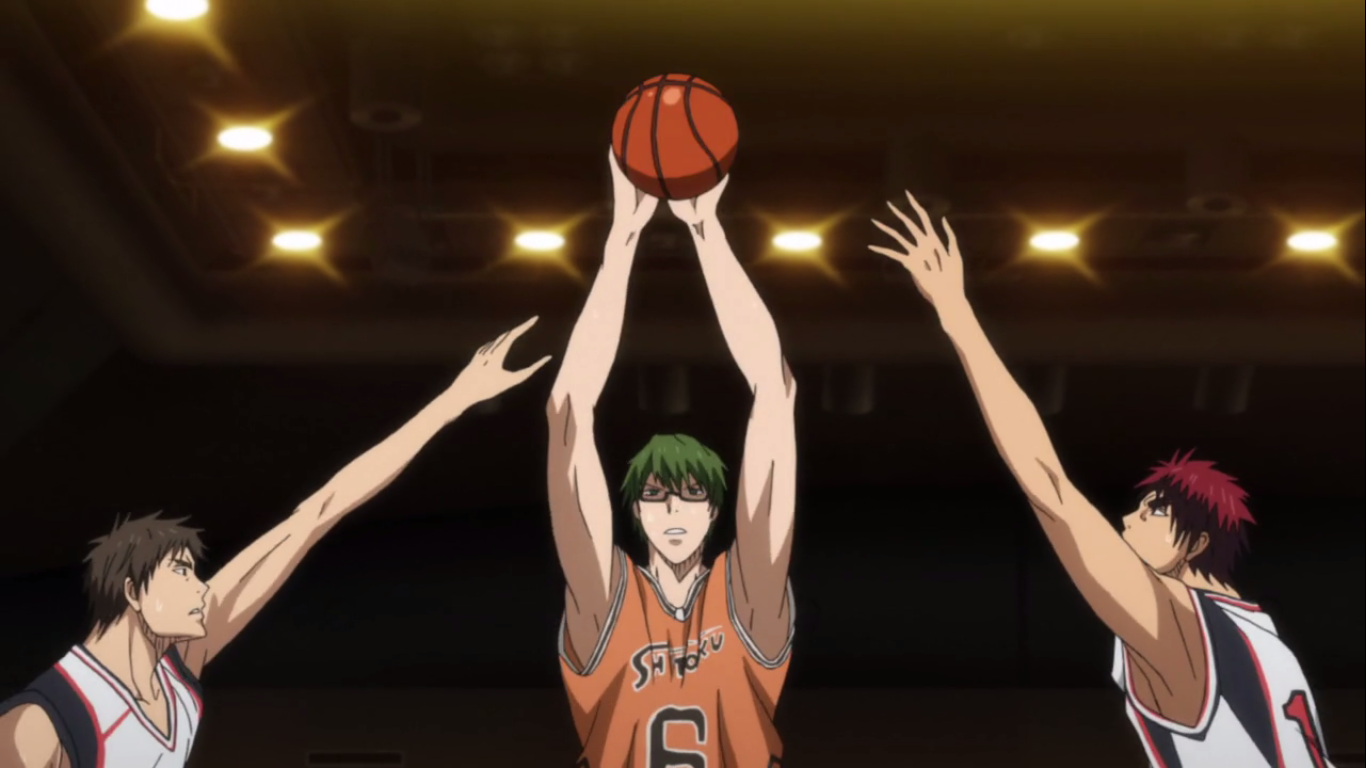
(Middle) Midorima

Kuroko uses his technique of misdirection to steal and create passes that cannot be anticipated by both teammates and opponents. He does this without being noticed by the other players while he moves around the court. This ability comes with a price however not only because the passes are unpredictable but Kuroko is prone to injury and fatigue as well. 

Overcoming these is what Kuroko has to do to contribute further to the team. Now that they have a prodigy of a player in Kagami, experienced upperclassmen and a good coach, Seirin looks poised to rise to the top in the inter-high school tournament. But will these be enough to beat the other schools that also have new players, some of which are from the Generation of Miracles?  Kise Ryouta, Midorima Shintarou, and Aomine Daiki have successfully raised their teams' competitive level and all of them are now rivals.


Aomine

Most sports anime usually have for a lead character either a prodigy or an average but promising athlete. Kuroko is a new specimen because he is a mediocre but overspecialized athlete with little promise of further improvement. Physically he isn't gifted and he doesn't even know how to shoot. In a physically demanding sports like basketball, a guy like this is unusual if not completely useless on court. Like most series of the genre, Kuroko no Basuke follows the story template of a rising team with new talent on its way to a national tournament. To get there Kuroko and the rest of Seirin have to face the former's talented ex-teammates.


Tetsuya #2

As for the other characters, Kuroko's teammates save Kagami are easy to forget because there is few or no character development at all. The known players from the Generation of Miracles however are easily distinguishable. In fact, there seems to be more focus on the stories and characters of Kagami, Kise, Midorima, and Aomine than on Kuroko. I guess that is consistent with his near-invisible ability.

The animation is beautifully done especially the matches. Even the opening and ending themes are action-packed. The pace is fast and the matches aren't always stretched in several episodes. There are few commentaries or analyses from bystanders on court during matches but the players themselves explain and show enough of the special moves that viewers can appreciate. Exaggeration of characters' on-court abilities of course is to be expected. Overall, the series has lived up to its hype.

Kagami and Kuroko
Rating: 9 out of 10

Comments

Popular Posts

Deities and Mythical Beings of the Davao Tribes

Note: I don't claim to be an expert in the mythology and religion of the six tribes featured here. My source for this information is Fay-Cooper Cole's The Wild Tribes of Davao District, Mindanao. This entry is solely a list for future references. The deities and mythological creatures here are from Fay-Cooper Cole's The Wild Tribes of Davao District, Mindanao . This is a list of the gods, goddesses, and spirits/spirit classes of the Bagobo, Bila-an, Kulaman, Tagakaolo, Ata, and Mandaya. I retained the spelling of the names found in the book. For full accounts of the myths and customs of the tribes, I recommend reading the book. BAGOBO Eugpamolak Manobo/Manama/Kalayagan  - first and greatest creator whose home is in the sky. Offerings for him should be white. Tolus ka balakat - name means "dweller in the balakat"; loves blood but not the flesh of humans and is one of the three deities for whom the yearly sacrifice is made. Mandarangan and Darago - husba...

An Analysis of the Enuma Elish (The Epic of Creation) or The Seven Tablets of Creation, A Babylonian Creation Myth

*Note: This was a term paper for a class. Since I don't know what grade the professor gave me (or of she even read the paper at all), I decided to post it here. The Enuma Elish is also called The Seven Tablets of Creation. It documents the Babylonian creation epic. It was recorded in seven clay tablets found at various locations including the infamous library of Ashurbanipal at Nineveh, discovered by Austen Henry Layard. The name of the hero of the epic varies depending on where the tablet is found. The most common version tells of Marduk as the hero. In other versions, the god of the city is considered the hero. Introduction The title of the epic is taken from its opening line “When in the height, heaven was not named...” The epic chronicles Marduk’s war against Tiamat. He leads the other gods against the old divinity who had turned against her children. Besides Marduk’s exploits, the epic also tells about the birth of the gods and goddesses and the creation of the universe....

The Ghost of Sparta: A Review of the God of War Series

Several adaptations of Greek Mythology in media have appeared over the years. Some were successful while the others have failed to represent the ancient Greeks. Among the most memorable I've encountered is this series. Not only was it able to illustrate the heroes, monsters and gods in myths, but also brought to the fore the often ignored question - what happens to the Greek pantheon after they defeated the Titans? It is unique because the hero in this game is not a hercules-achilles-jason clone. The protagonist is a minor figure in Greek mythology. Kratos (Cratos) is a servant of the gods and one of Zeus' children, which is close enough to the real version (Cratos is not a child of Zeus, but one of his servants along with Nike). And unlike most heroes, he does not carry weapons to save humanity. He seeks revenge to cleanse his past. The series began when he sought to kill Ares, the God of War.  He was finally able to kill Ares with the help of the other gods. The portrayal...

Literary Theory and Criticism

Note: This is my final paper for Adv. Literary Theory and Criticism, one of my classes in MA in Literature.  October 2015. I'm posting this here as a backup in case I lose my copy and I need a guide in the future. Literature is the soul of a civilization. It is the collection of dreams, ideas and experiences of a people. It is what separates us from animals. It is an examination of our aspirations, happiness, fears and sadness, ideas and opinions. As a student of literature, I have learned that to get the most out of a poem, short story, novel, play or film, I must go beyond simple reading and observation. To do this however, I have to answer first the question "how do we fully appreciate a literary piece?" This essay is divided into four sections, namely; what is literature for me; the literary theories and criticism; Heneral Luna: a film review using the poststructuralist approach; and what makes a good literature? In the first part, I will recall my experiences a...